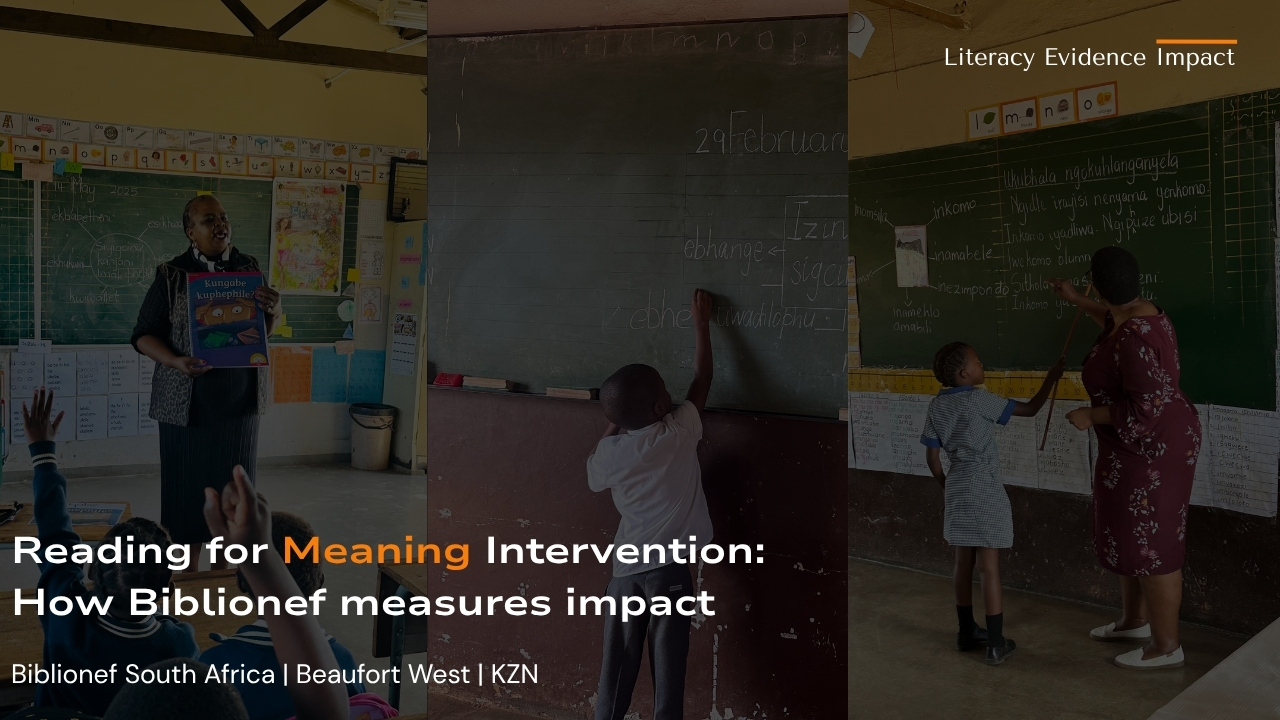
Many children in South Africa learn to read but struggle to understand what they read.
Since 2016, Biblionef has been building and refining a Reading for Meaning approach designed to address this challenge. The journey has included classroom interventions, teacher development, follow-up assessments, and independent external evaluation.
This article reflects on what we have learned so far.
What a reading for meaning intervention looks like
Biblionef’s approach rests on three pillars: quality books, practical teacher training, and sustained classroom support. Teachers learn to use shared reading, shared writing, and higher-order questioning. Children move from low-order tasks like word recognition toward thinking, discussing, and interpreting texts. The methodology is grounded in CAPS requirements. It does not add to teachers’ workloads, but changes how they use the time they already have.
The Beaufort West pilot: building an evidence base
In 2016, Biblionef launched a 21-month reading-for-meaning intervention at ten primary schools in the Beaufort West district. The DG Murray Trust, the SALI Trust, and the Western Cape Education Department supported the project and childhood literacy specialist Marlene Rousseau led it.
Rousseau ran six workshops and spent six days at each school, supporting teachers directly in their classrooms. She also conducted a mixed-impact study to measure the effect on teachers and children.
The baseline told a familiar story. Most classrooms had little or no reading material, and teachers lacked practical training in teaching reading for meaning. Children spent most of their time on low-order tasks, with very little focus on thinking about or interpreting texts.
By the end of the project, the picture had shifted. Teachers deepened their practice; they used stories as the centre point of lesson planning, children began to express ideas through drawing and writing, and higher-order thinking moved to the foreground.
What happened after the project ended
The SALI Trust funded a follow-up assessment in 2021, conducted by Rousseau. She returned to nine of the schools to find out whether the changes had lasted.
The results were striking. Six of the nine schools showed systemic improvements in reading scores of 100% to 200% between 2016 and 2018, the year after the project ended. Education evaluator Angela Schaffer-Smith confirmed Rousseau’s findings. Between 60% and 70% of the donated books showed signs of sustained, active use.
These results gave Biblionef confidence but also raised an honest question. Internal evaluations, however rigorous, carry a limitation: Biblionef ran the intervention and assessed it. We needed to know whether independent scrutiny would confirm our findings.
Taking the next step: independent external evaluation in KwaZulu-Natal
The Inchanga Circuit project was funded by Woolworths (previously MySchool, MyVillage, MyPlanet) between 2023 and 2025. The project supported Foundation Phase teachers at 10 schools in KwaZulu-Natal and gave us the opportunity to conduct external assessments. This time, we commissioned an independent external evaluation from the start.
Dr Sandra Land led the evaluation, and she and her team had no stake in the outcome. They observed workshops, interviewed teachers, principals, and DBE officials, collected data from children, and reported their findings, including where improvements are needed.
The evaluation spanned the full three years of the project. A baseline established what teachers knew before the reading-for-meaning intervention began, and formative reports tracked change at regular intervals. A summative report, due in 2026, will deliver the final assessment.
What the formative reports show so far
The baseline confirmed what Beaufort West had already revealed. Fewer than half of the participating teachers could accurately describe the key concepts in Biblionef’s approach. Teachers trained at universities showed the sharpest gaps, reflecting a broader shift away from practical classroom methods in higher education.
The formative reports show real movement. Teachers who started the project with doubts, including some who, after twenty years in the classroom, believed they had nothing left to learn, describe acquiring entirely new skills. They have learned how to introduce stories effectively, how to link reading and writing, and how to pose higher-order questions.
The evaluators also observe children directly. Across the three sample schools, children engage actively with Biblionef books, which teachers describe as more varied and appealing than their existing class readers.
The evaluation also surfaces challenges. Dr Land notes that large classes make it difficult to provide differentiated support, and self-reported change does not always translate into sustained classroom practice. Biblionef includes these findings in its reporting.
Why rigorous evaluation matters
The progression from Beaufort West to KwaZulu-Natal reflects how Biblionef thinks about evidence. Internal evaluation produced strong early results and shaped how we work today. External evaluation gives funders, partners, and the public something we cannot provide ourselves: independent verification.
The summative report, once complete, will offer the fullest account yet of what a sustained reading-for-meaning intervention can achieve. Biblionef plans to submit findings for peer-reviewed publication. We believe this evidence should contribute to the broader literacy research community, not only our own work.