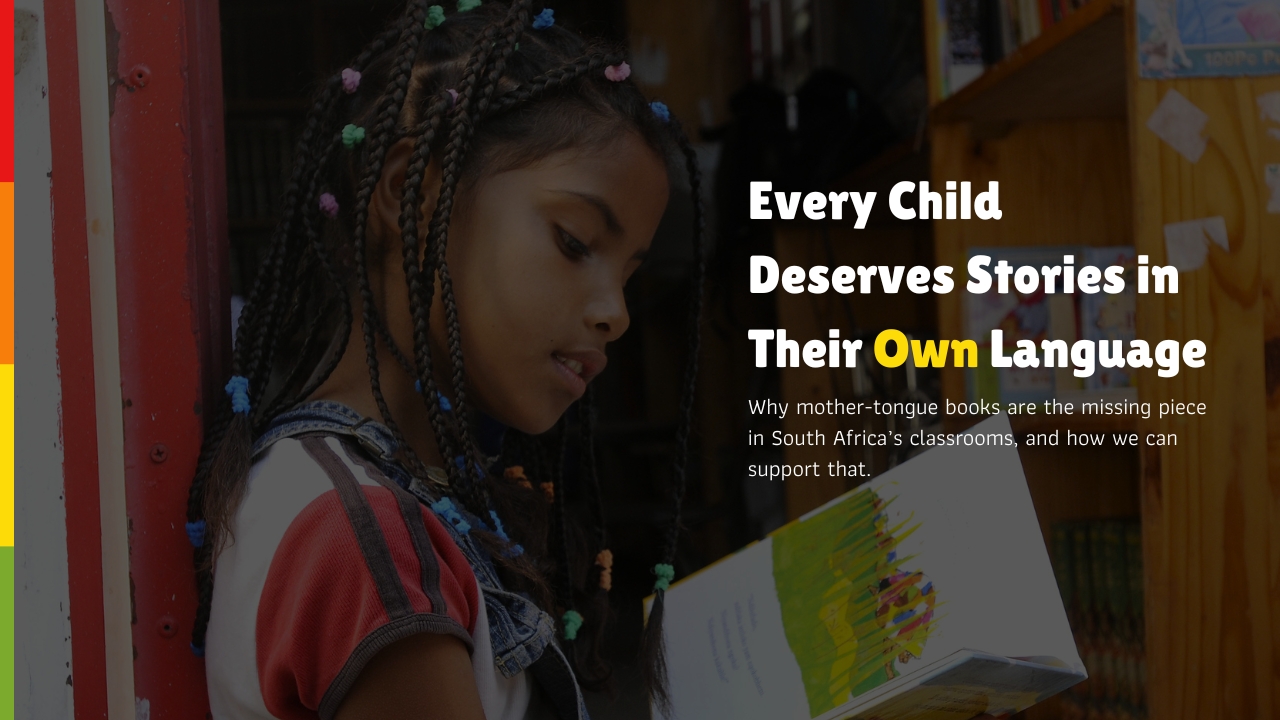
Every child deserves stories that resonate with them. When these stories are in a child’s home language, the impact is immediate and profound. Mother-tongue-based bilingual education (MTBBE) is a transformative educational model that ensures children begin learning in the language they are most familiar with while also having access to English, thereby giving them the best of both worlds. Our own local example of Afrikaans schools teaching children in their mother tongue consistently demonstrates the value of mother-tongue education. Also, global research (Malherbe & Haarhoff, 1943; Bamgbose, 2005; MacDonald & Burroughs, 1991; Thomas & Collier, 2002) shows that this approach accelerates children’s learning, enhances their sense of security in the classroom, and instils a lifelong love for reading, offering a beacon of hope for the future of education.
Biblionef South Africa operates where the need is the greatest: we publish, distribute, and advocate for the use of children’s books in the languages children speak every day. This is not just a theoretical concept; it is practical work that transforms classrooms and shapes the future of our children.
What is mother-tongue-based bilingual education?
Mother-tongue-based bilingual education is a simple idea. Children start school using their home language for instruction, reading and writing. A second language, usually English or Afrikaans, is introduced later as a second medium of instruction alongside the home language and is also taught as a second language. The aim is not to replace the home language. The aim is to build a strong foundation in it, then transfer skills taught in the home language to learning additional languages. The United Nations Educational, Scientific and Cultural Organisation (UNESCO) calls this approach one of the most effective ways to improve learning outcomes in multilingual countries (UNESCO, 2003).
Why it works
- Children learn better. Children learn better when taught in their mother tongue. Evidence drawn from multiple developing countries across Africa and Asia demonstrates that children taught in their home language learn to read more quickly and achieve stronger comprehension than those taught in an unfamiliar language (Alidou et al., 2006; Benson, 2000). A solid foundation in the home language also facilitates the transfer of literacy skills to additional languages, including English.
- Children connect more deeply. Books written in a child’s home language carry familiar sounds, expressions, and cultural references. This makes it easier for children to relate to stories, feel seen, and build confidence. In South Africa and across the African continent, learners taught in their mother tongue show higher participation in lessons and develop greater self-esteem and confidence (Trudell, 2016; Cummins, 2000).
- Children fall in love with reading. When children understand what they read, they enjoy it. Enjoyment builds confidence and curiosity, which fuels a habit of reading for pleasure. International research, including findings from the Organisation for Economic Co-operation and Development (OECD), shows that reading for enjoyment is one of the strongest predictors of long-term academic success (OECD, 2010).
How government policy sets the tone
South Africa has recognised the importance of language in education. The Department of Basic Education’s policy requires that children be taught in their home language from Grade R to Grade 3, while introducing English or Afrikaans as an additional language. With the implementation of MTBBE, there is no longer a transition away from the home language in Grade 4. Instead, both languages are used alongside one another as languages of learning and teaching, supporting a bilingual approach to education beyond Grade 3.
MTBBE is, in essence, additive bilingualism. While the concept of additive bilingualism originated internationally, it has been given a local framing through MTBBE. This approach aligns with South Africa’s Language in Education Policy (LIEP) of 1997, which encourages schools to strengthen learners’ home languages while introducing additional languages. This policy sets the tone for the education system and highlights why mother-tongue resources, books, teachers, and training are so critical.
The challenges in practice
Despite progressive policies, schools continue to face numerous challenges. Studies show that there are not enough storybooks, learning materials, or trained teachers in African languages to meet demand (Heugh, 2011). Many parents, hoping for better job opportunities for their children, also advocate for early English-medium education, sometimes overlooking the proven benefits of mother-tongue foundations. Without adequate resources and support, mother-tongue-based bilingual education often remains an aspiration rather than a daily classroom reality.
Strategies for overcoming challenges
While resource shortages remain a significant barrier, there are practical strategies schools and communities can use to strengthen mother-tongue-based bilingual education. These strategies provide actionable solutions and encourage the implementation of mother-tongue-based bilingual education:
- Shared resources: Schools can form clusters to share books and teaching materials, ensuring wider access even with limited budgets.
- Teacher creativity: Teachers often create low-cost resources such as story cards, posters, or classroom-made books using children’s own stories and experiences.
- Parental encouragement: Parents can be encouraged to read, tell stories, and write with their children in their home language while also valuing additional languages as tools for future opportunities. This balanced approach reassures families that mother-tongue education strengthens, rather than weakens, English or Afrikaans learning.
- Community-led success stories: In Ethiopia, Mozambique, and parts of South Africa, community-driven bilingual programmes have successfully raised reading levels and strengthened cultural identity (Heugh et al., 2007; Benson, 2000; Alidou et al., 2006). These models demonstrate that when local schools, parents, and organisations collaborate, children benefit academically and socially.
The role of communities and parents
Communities and families play a crucial role in ensuring the success of mother-tongue education. Research shows that when parents help create, read, and share books in their own languages, children’s reading skills improve significantly. Schools that work with local authors, translators, and cultural groups not only boost language learning but also make education more inclusive and meaningful.
Long-term impacts on children
The benefits of mother-tongue learning are long-lasting, extending well beyond the early years. International longitudinal studies have demonstrated that learners in strong bilingual programmes not only achieve higher academic results in secondary education but also experience greater self-identity and emotional well-being (Thomas & Collier, 2002). For South African children, this means not just passing exams but gaining the confidence and resilience to succeed in a multilingual society.
What this looks like in the classroom
A teacher using mother-tongue-based bilingual education can explain new ideas in the language children already know. She can read a story in isiXhosa, for example, and then use the same story to introduce English vocabulary. Many teachers have been using this method, academically called translanguaging, which involves moving naturally between languages, to help children make connections across languages (DBE Circular 18, 2024). A significant body of research indicates that this approach improves understanding and keeps learners more engaged.
Why books are the missing piece
Books are the practical tools that make this policy effective. Without storybooks in children’s languages, teachers face limitations. A library full of English books offers little benefit to a Grade 1 class that is still learning the language. Books in isiZulu, Sesotho, or Tshivenda are not just “nice to have”; they are vital for children to understand meaning, expand their vocabulary, and develop a love for reading.
Biblionef’s role: filling a critical gap
Biblionef South Africa bridges the gap between policy and practice. We:
- Publish and source quality books in South Africa’s languages by working with local authors and translators.
- Distribute these books to schools and libraries where they are needed most.
- Support foundation-phase teachers and librarians with training on using mother-tongue books in everyday lessons.
Our three-year literacy project in KwaZulu-Natal, supported by Woolworths (previously MySchool MyVillage MyPlanet), showed how powerful this approach can be. Teachers who received books in learners’ home languages and support on how to use them reported more participation in class, greater curiosity, and a noticeable improvement in children’s confidence.
A call to action
If we care about literacy, we must care about language. Supporting mother-tongue books is not just about culture; it is about giving children the best possible chance to succeed in school and in life.
Biblionef South Africa invites donors, partners, and communities to work with us. By publishing, distributing, and supporting the use of mother-tongue books, we can give every child stories that reflect their lives and open windows to new worlds.
For the Curious
Alidou, H., Boly, A., Brock-Utne, B., Diallo, Y. S., Heugh, K., & Wolff, H. E. (2006). Optimizing learning and education in Africa–the language factor. Paris: ADEA.
Bamgboṣe, A. (2005). Mother-tongue education: Lessons from the Yoruba experience. In B. Brock-Utne & R. K. Hopson (Eds.), Languages of instruction for African emancipation: Focus on postcolonial contexts and considerations (pp. 231–257). Cape Town: CASAS and Mkuki na Nyota Publishers.
Benson, C. J. (2000). The primary bilingual education experiment in Mozambique, 1993 to 1997. International Journal of Bilingual Education and Bilingualism, 3(3), 149-166.
Benson, C. (2005). Girls, educational equity and mother tongue-based teaching. Bangkok: UNESCO.
Bloch, C., & Alexander, N. (2003). A luta continua!: The relevance of the continua of biliteracy to South African multilingual schools. In N. H. Hornberger (Ed.), Continua of biliteracy (pp. 91–121). Clevedon: Multilingual Matters.
Cummins, J. (1996). Cummins, J. (1996). Negotiating identities: Education for empowerment in a diverse society. Ontario, CA: California Association for Bilingual Education.
Cummins, J. (2000). Language, power, and pedagogy: Bilingual children in the crossfire (Vol. 23). Multilingual matters
Cummins, J. (2009). Bilingual and immersion programs. The handbook of language teaching, 159-181. In M. H. Long & C. J. Doughty (Eds.), The handbook of language teaching (pp. 159–181). Oxford: Wiley-Blackwell.
Department of Basic Education. (2010). The status of the language of learning and teaching (LOLT) in South African public schools: A quantitative overview. Pretoria: Department of Basic Education.
Department of Basic Education. (2024). Circular 18 of 2024. Pretoria: Department of Basic Education.
García, O., Johnson, S. I., & Seltzer, K. (2017). The translanguaging classroom: Leveraging student bilingualism for learning. Philadelphia: Caslon.
Heughs, K. (2000). The Case against Bilingual and Multilingual Education in South Africa. Praesa Occasional Papers No. 6, Cape Town: PRAESA.
Heugh, K., Benson, C., Bogale, B., & Yohannes, M. A. G. (2007). Study on medium of instruction in primary schools in Ethiopia.
Heugh, K. (2011). Theory and practice-language education models in Africa: Research, design, decision-making and outcomes.In A. Ouane & C. Glanz (Eds.), Optimising learning, education and publishing in Africa: The language factor (pp. 105–156). Hamburg: UNESCO Institute for Lifelong Learning.
Malherbe, E.G., & Haarhoff, T.J. (1943). The bilingual school: a study of bilingualism in South Africa.
MacDonald, C., & Burroughs, E. (1991). Eager to talk and learn and think. Cape Town: Maskew Miller Longman.
Ngũgĩ wa Thiong’o. (1986). Decolonising the mind: The politics of language in African literature. London: James Currey.
Organisation for Economic Co-operation and Development. (2010). PISA 2009 results: Learning to learn – Student engagement, strategies and practices (Volume III). OECD Publishing. https://doi.org/10.1787/9789264083943-en
Ouane, A., & Glanz, C. (2011). Optimising Learning, Education and Publishing in Africa: The Language Factor–A Review and Analysis of Theory and Practice in Mother-Tongue and Bilingual Education in Sub-Saharan Africa. UNESCO Institute for Lifelong Learning. Feldbrunnenstrasse 58, 20148 Hamburg, Germany.
Probyn, M. (2009). ‘Smuggling the vernacular into the classroom’: Conflicts and tensions in classroom codeswitching in township/rural schools in South Africa. International journal of bilingual education and bilingualism, 12(2), 123-136.
RTI International. (2015). Reading within reach: A framework for planning and implementing early grade reading interventions. Research Triangle Park, NC: RTI Press.
Thomas, W., & Collier, V. (2002). A national study of school effectiveness for language minority students’ long-term academic achievement.
Trudell, B., & Piper, B. (2014). Mother tongue literacy in sub-Saharan Africa: The role of mobile learning. In M. Ally & A. Tsinakos (Eds.), Increasing access through mobile learning (pp. 139–150). Vancouver: Commonwealth of Learning.
UNESCO. (2016). If you don’t understand, how can you learn? Global Education Monitoring Report: Policy Paper 24. Paris: UNESCO. Retrieved from https://unesdoc.unesco.org/ark:/48223/pf0000243713
Trudell, B. (2016). The impact of language policy and practice on children’s learning: Evidence from Eastern and Southern Africa. UNICEF Eastern and Southern Africa Regional Office.
UNESCO. (2003). Education in a multilingual world. UNESCO Education Position Paper. Paris: UNESCO.