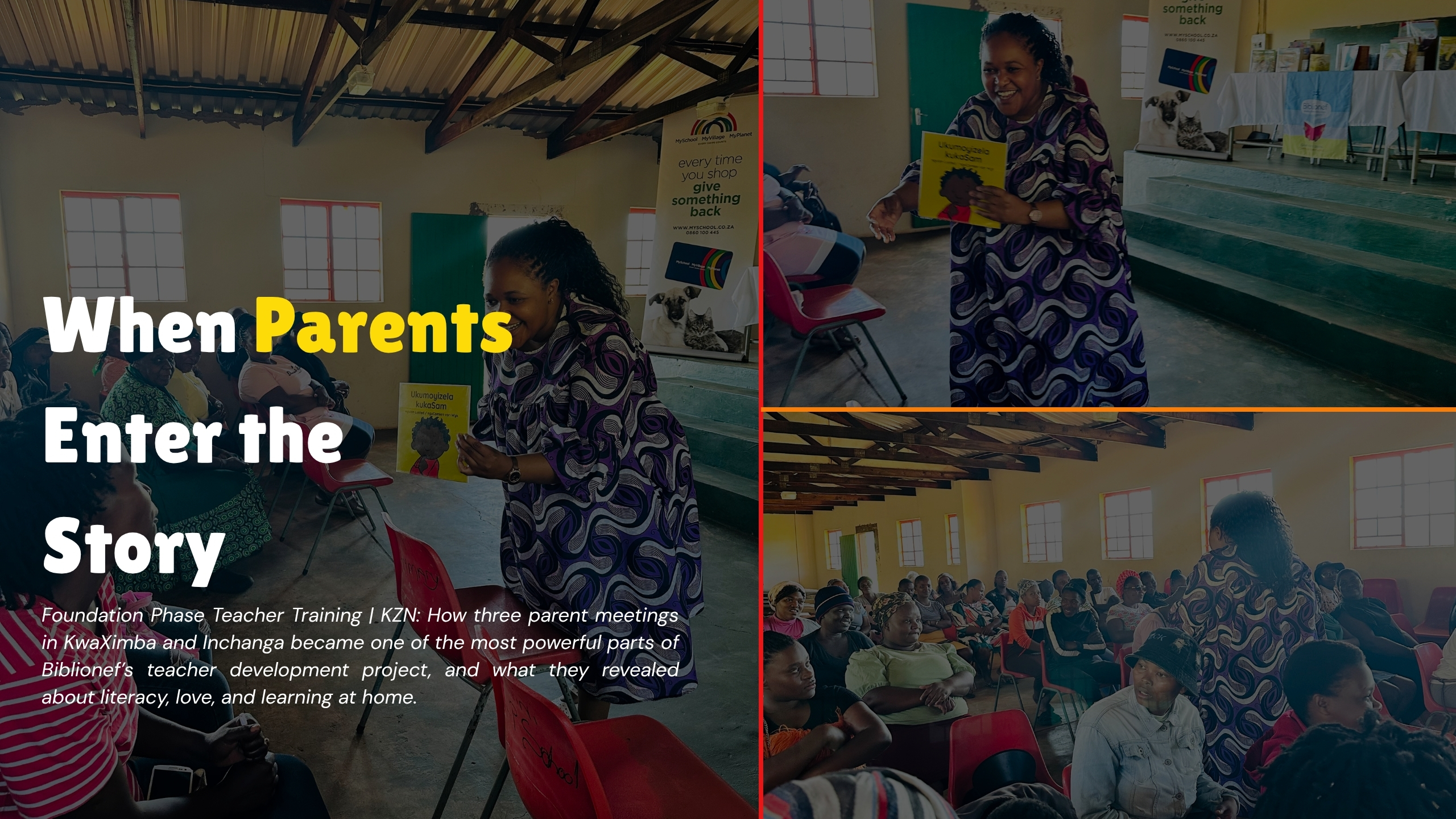
In 2025, Biblionef hosted three parent meetings in KwaXimba and Inchanga as part of our 3-year teacher development project funded by Woolworths (previously MySchool MyVillage MyPlanet). What started as an idea from a single teacher became one of the most powerful components of the entire intervention.
Three Meetings, Three Communities, Countless Revelations
Our first meeting was held at a quintile 2 school deep in the Umngeni Valley. We expected a small turnout for a mid-morning weekday meeting. Instead, 79 parents and caregivers arrived, including four fathers, a rare sight at school meetings in this context.
When our team read Ukumoyizela kukaSam (Sam’s Smile), a story about a child who refuses to smile despite being showered with treats, parents shared their views. Most believed Sam needed discipline. But as we discussed the story, one mother stood up and bravely admitted she hits her son out of frustration because his homework now surpasses her own education. She left the meeting in tears.
Outside, she told our evaluator1 that she had once attended an adult literacy class but dropped out because of shame. Still, she held on to hope and said she would stop beating her child. Her vulnerability unlocked something for all of us.
At another primary school (quintile 3 school), more than 50 parents attended. This time, we brought in Nal’ibali to share joyful, practical tips for reading at home. Parents saw how stories could be playful; how simple it is to engage a child, even for just 10 minutes a day.
Sam’s story was shared again. This time, some parents still suggested punishment, but many said they’d try to understand what was really wrong. When they learned that Sam smiled after being hugged, the room broke into applause.
The third meeting at a quintile 4 school looked different: a well-resourced school, with fewer parents (just 12) but a deeper conversation. No one mentioned corporal punishment. Instead, parents reflected on their own upbringings and how they hoped to do better with their children. One mother said she had finally come to understand that love is part of the learning process.
What the Meetings Revealed: The Invisible Divide
Our external evaluators noted something striking in their reports: parents’ attitudes towards communication with children resonated almost perfectly with research on socio-economic differences in verbal engagement.
The landmark study by Hart and Risley (2003) suggested that children in poor, disadvantaged families hear 30 million fewer words in the first four years of their lives than children in well-resourced, privileged families.
Our three parent meetings seemed to reflect this finding with uncanny precision:
- Quintile 2 school: Parents initially reported having no time to talk with their children.
- Quintile 3 school: Some were reluctant, but most said they would talk to discover what was troubling a child.
- Quintile 4 school: Unanimous agreement that they would talk with the child first.
Even more telling: these responses matched exactly what children had told us earlier in the project about being read to at home. When we interviewed 36 children across the three schools in 2024:
- Zero children from the quintile 2 school remembered being read to at home.
- Almost half of the children from the quintile 3 school could remember someone reading to them.
- Most children from the school in quintile 4 remembered being read to at home.
The Deeper Understanding
These meetings led our evaluators to a sobering conclusion documented in their reports:
“These observations must lead to the realisation that although their individual circumstances will naturally vary, children in impoverished communities may well be contending with a range of hardships beyond those which are immediately apparent:
- The communication they have with adults may not be sufficiently supportive and detailed for them to develop the vocabulary and language skills necessary for academic success.
- Their homes are likely to have very limited or no books or other texts.
- They may not be able to find help from others in their household with homework.
- They are likely to be recurrently beaten at home, perhaps by parents who feel anger in the realisation of their own educational inadequacy, and research tells us this does lasting damage to self-image and confidence.
- They may suffer hunger at home.
- The schools they attend are poorly resourced.
- They may spend considerably less time being taught in class than children from wealthier communities.”
This was no longer statistics. These were the faces in the rooms where we gathered. The mother who wept. The grandmother on crutches who arrived ninety minutes late but still came. The father who attended because he believed education could transform his child’s life.
What We Learned
These meetings revealed the deep impact of socio-economic context on how children are spoken to and listened to at home. They confirmed research showing how communication styles differ across communities, affecting children’s vocabulary, confidence, and academic outcomes (see Alexander, 2005). But they also showed something else: parents care deeply. They just rarely get the space to show it.
Why We’re Taking This Forward
We’ve always suspected that literacy doesn’t end at the school gate, and these meetings confirmed it. When parents are involved, something shifts. Not only in how children learn, but also in how they see themselves as learners.
Our pilot parent sessions in KwaXimba and Inchanga have made this clear. While short and introductory by design, these meetings planted important seeds in parents’ minds. What truly deepened our understanding was comparing our observations during the parents’ meeting with the children’s own words (see the heading “What the Meetings Revealed: The Invisible Divide”). This correlation between schools with higher parent engagement and children who reported positive literacy experiences at home prompted us to reimagine our role. If we want to build a true culture of reading, then parents can’t be on the sidelines. They are, in many cases, children’s first storytellers. And often, their most powerful ones.
So, this is not the end. The small moments we experienced, the questions, the laughter, and the pride, are what motivate us to keep this work going. Moving forward, Biblionef will incorporate one parent engagement session per year into our Foundation Phase Teacher Training projects, a small but deliberate commitment to making parents part of the process.
Where possible, we will also work with organisations already supporting families in the communities we serve. There are people doing deep, sustained work with parents in these areas, and it makes more sense to work alongside them than to work in parallel. Our role is to contribute what we know about reading and books; theirs is to hold the longer relationship with families.
Our goal is not to build something new from scratch, but to connect what already exists: families, schools, community organisations, so that children are surrounded by reading wherever they are. These meetings showed us what’s possible when we open the door and invite parents in. To the parents who showed up, the teachers who made space for them, and the partners who funded this work: thank you. The door is open. We intend to keep it that way.
- Land, S. and Thusi, Z. (2025). Fifth evaluation report on the Biblionef project: Providing storybooks and mentoring to Foundation Phase teachers at 10 schools in the Inchanga Circuit. Cape Town: Biblionef. Unpublished formative evaluation report. ↩︎
For the Curious
Alexander, R. (2008). Culture, dialogue and learning: Notes on an emerging pedagogy. Exploring talk in school, 2008, 91-114.Compton-Lilly, C. (2007). Reading Families: The Literate Lives of Urban Children. Teachers College Press.
Epstein, J. L. (1995). School/family/community partnerships. Phi delta kappan, 76(9), 701.
Heath, S. B. (1983). Ways with Words: Language, Life and Work in Communities and Classrooms. Cambridge University Press.
Mol, S. E., & Bus, A. G. (2011). To read or not to read: a meta-analysis of print exposure from infancy to early adulthood. Psychological bulletin, 137(2), 267.